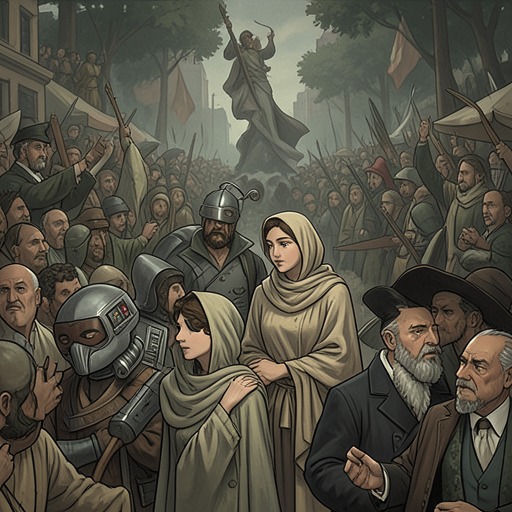
Gwynplaine and Dea's love and marriage
The Man Who LaughsGwynplaine and Dea's love and marriage is a bond of mutual devotion that gives meaning to both their shared past and their final reunion. Their life in the Green Box is remembered as a happiness built from closeness, songs, and performance, while the last hours aboard ship expose how completely each has become necessary to the other. Dea’s death ends their life together; Gwynplaine, unable to remain without her, leaps into the water.
A shared life in the Green Box
Dea remembers their time in the poor caravan as a life of happiness and constant companionship. Their songs and the applause at their performances were part of that life, but its deepest comfort was the assurance that they would not be separated. She describes herself as living in a cloud with Gwynplaine, her blindness notwithstanding: his voice told her when morning had come, and dreaming of him marked the night. Her sense of time and home is thus attached not to sight or surroundings but to his presence.
That recollection makes their relationship more than an affection recalled at the end of Dea’s life. Gwynplaine is the point by which she understands the daily world; the shared life of the Green Box is valuable to her because it is a life lived with him. She also remembers the sound of her own voice telling him that she loved him, asking him not to forget either the words or the way she spoke them. Their bond is expressed through performance and listening as well as through physical closeness.
Reunion and dependence
When Gwynplaine finds Dea again, their reunion comes after he has just undergone a startling change in fortune. He tries to explain that he has explored life and found nothing in it apart from her: she is what gives the universe meaning. The declaration presents his love not as one attachment among many, but as the foundation on which his understanding of life rests. He begs her to stay, insisting that they have been together again for only a few minutes and that their recovered happiness should not be taken from them at once.
His plea is also an admission of dependence. He calls Dea his divinity and love, says he has only her, and tells her that he cannot bear her death. His language turns from commands that she live to entreaties and promises that all will be well. He says that he could not help leaving when he was summoned away, and asks her to forgive the separation. His efforts cannot change her condition, but they reveal how urgently he experiences their reunion as a return to the life that matters.
Dea’s farewell
Dea initially tells Gwynplaine that she wanted to die an hour earlier, but no longer does; she nevertheless recognizes that she is dying. She regards their happiness as something granted and then withdrawn, and speaks of going first as a fate already decided. Her farewell gathers their intimate life into concrete memories: the Green Box, her songs, Gwynplaine’s voice, their caravan, and the joy of never being parted. She also names Ursus and Homo as beloved family and remembers Fibi and Vinos with affection, because they were present in the happiness they shared.
Her words show that the relationship extends into a small community of shared affection, without displacing Gwynplaine as its center. Dea recalls having been jealous of a woman who once came, though she does not identify the woman; the confession is an intimate detail offered as she takes stock of her life with him. She wishes to remain in the dress she is wearing because it bears Gwynplaine’s kisses and, in her earlier foreboding, had seemed destined to become her shroud. Even in the final separation, their love is represented through touch, voice, clothing, and remembered routine.
Gwynplaine collapses at Dea’s feet and holds her feet in his hands, sobbing that he cannot consent to her death and that they should die together rather than be separated. Dea answers that his efforts cannot save her and asks him to remember her. In her last appeal, she asks him to come to her as soon as he can, saying that she will be unhappy without him even in heaven. The scene makes the difference between their wishes plain: he begs her to remain, while she, still loving him, can only bid him farewell.
Death and the final separation
As Dea dies, Gwynplaine presses his mouth to her icy hands. She raises herself, her eyes flash with an intense brightness, and she cries that she sees before falling back motionless. The moment gives her blindness a final, sudden reversal, but it does not restore the life the lovers hoped to share. Her brief vision occurs at the instant of death, so the reunion ends not in renewed earthly companionship but in an irreversible parting.
Gwynplaine’s response completes the tragic arc of their relationship. At the ship’s edge, he steps into the void, declaring that he is coming to Dea. The water swallows him; no one sees or hears him, and the ship continues on until it reaches the sea. Homo remains at the edge, looking down into the water, while Ursus later discovers that Gwynplaine is gone. The ending makes Gwynplaine’s earlier insistence that life has no meaning without Dea literal: after her death, he chooses not to continue without her. Their love is therefore both the sustaining center of their shared life and the force that shapes its final, fatal separation.